
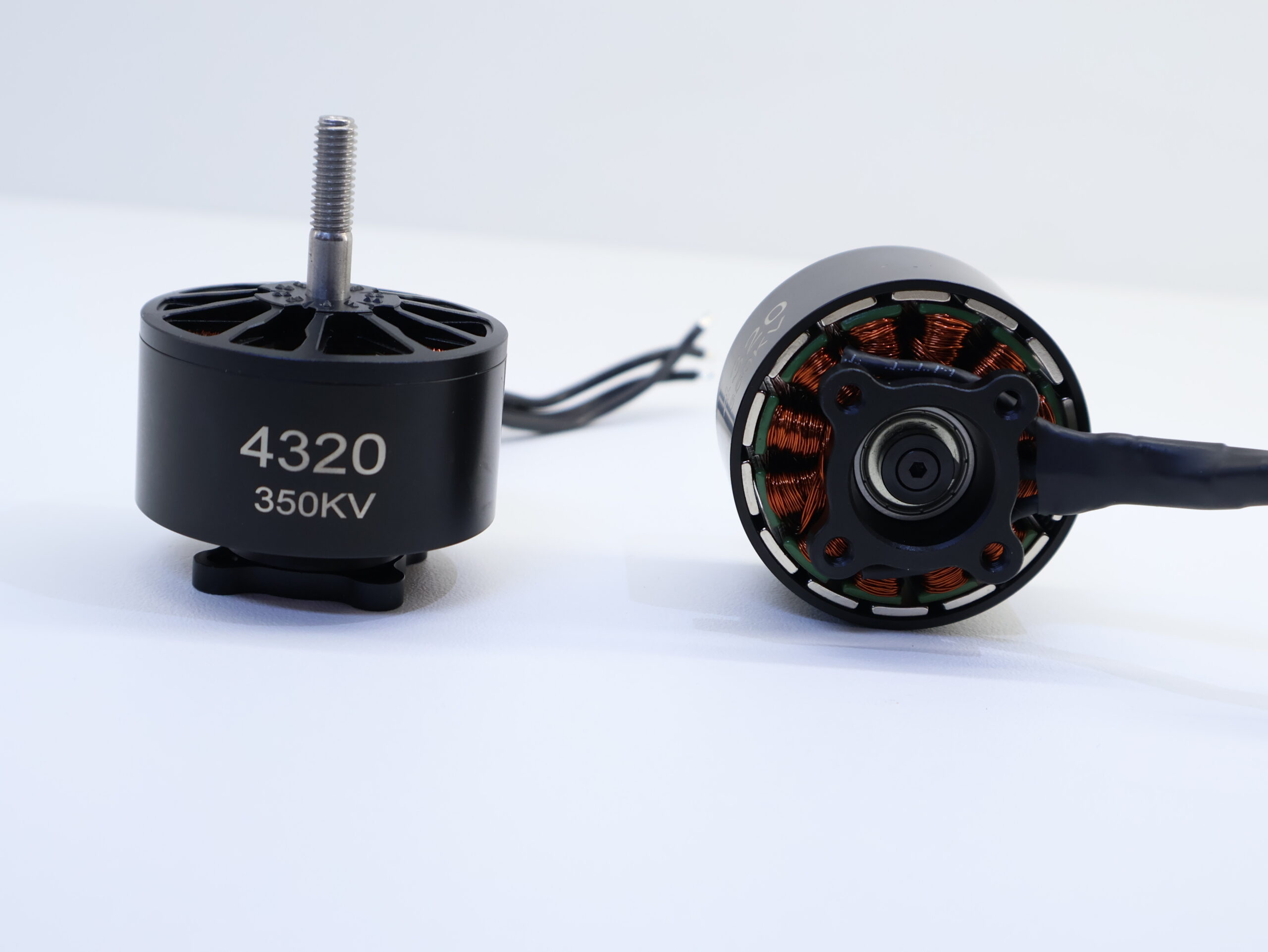
4320-350KV Motor Review: Heavy Lift Performance & 12S Efficiency
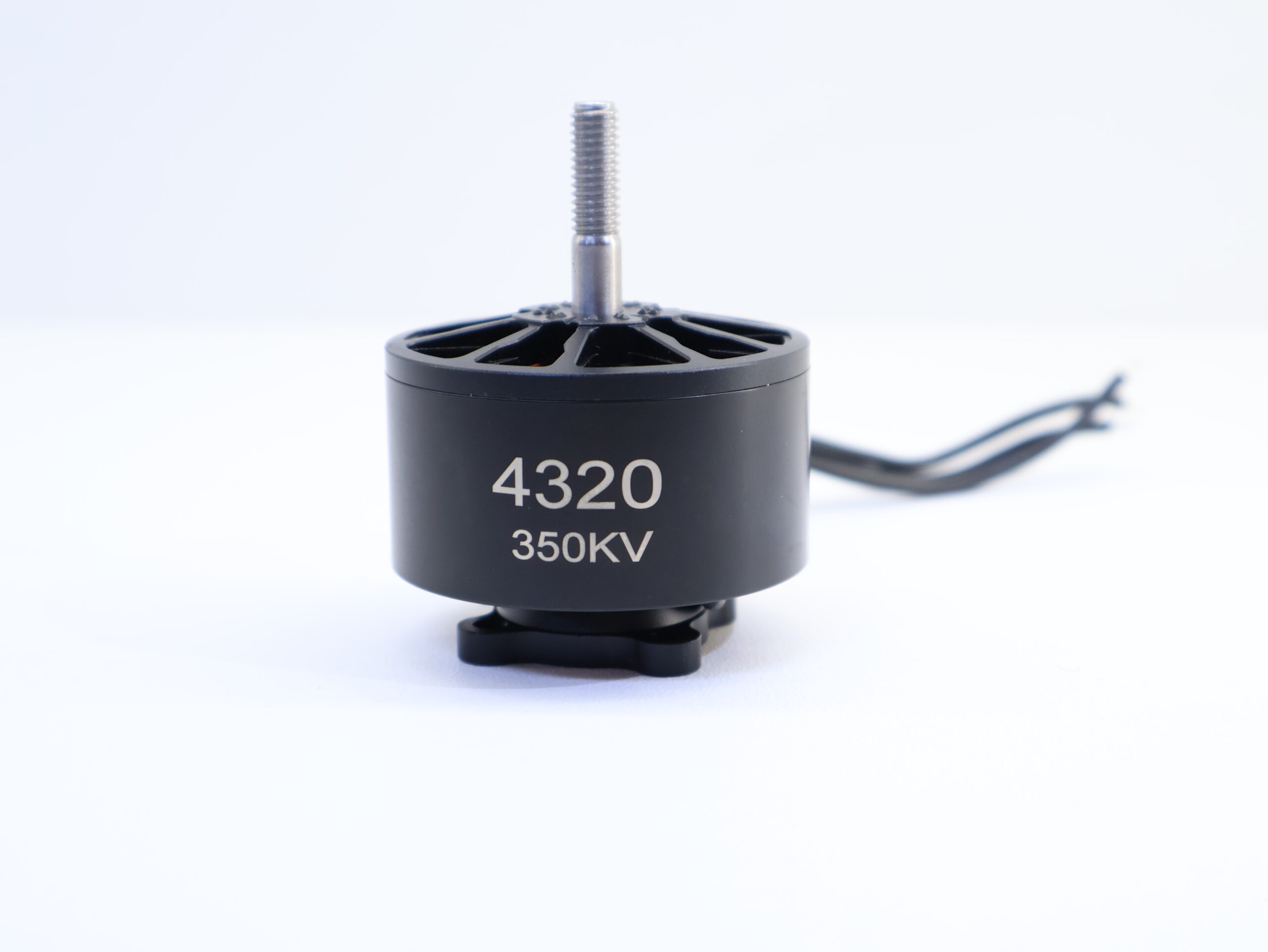
Most drone motor reviews give you peak thrust and a spec sheet. Here's the problem: a motor that hits 9.8 kg thrust at full throttle may be useless at 50% cruise — which is where heavy-lift UAVs spend 80% of their flight time. That's why we tested the 4320-350KV with four different propellers across a full 10-point throttle sweep. Below, we break down exactly what the data says — and why this motor has become our go-to recommendation for operators lifting 20 kg or more.
Specifications at a Glance
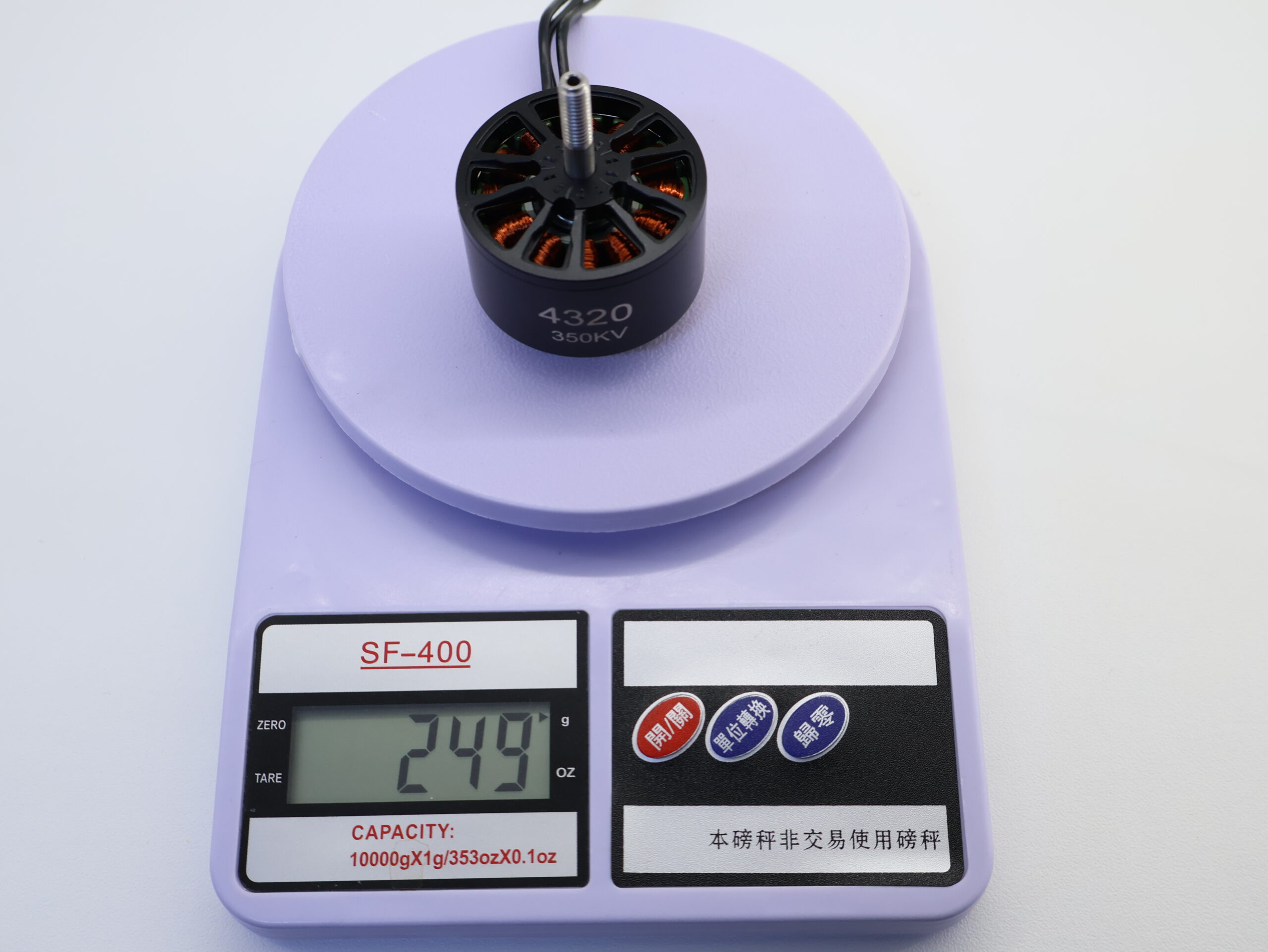
At 248 grams, the 4320-350KV sits in an interesting spot — it's lighter than the 5315-420KV but produces comparable peak thrust on the right propeller. The 12N14P configuration with 350KV means higher torque at lower RPM, which translates to better efficiency with larger propellers.
Thrust Test: 4 Propellers, Full 10-Point Throttle Sweep
We tested the 4320-350KV with four different three-blade propellers on 12S — scanning every 10% throttle from idle to wide open. Here's the data that matters most. The DBone 15×7.3×3 is our recommended configuration for maximum payload; we include it in full below. The other three propellers are shown in the comparison table that follows.
DBone 15×7.3×3 — The Heavy-Lift Configuration
The critical data point for heavy-lift operators: at 50% throttle — a realistic cruise setting for a loaded hexacopter — the motor delivers 3,632g thrust at just 14.8A. That's 4.94 G/W efficiency, and across six motors on a hexacopter, you get roughly 21.8 kg total cruise thrust while drawing only 89A from your 12S pack. For a 25L sprayer drone, that's exactly where you want to be.
Four-Propeller Comparison — Key Data Points at 50% Throttle
One thing jumps out immediately: the 4320 is happiest with props in the 13-15" range. The 15×7.3×3 gives the highest absolute thrust — nearly 10 kg per motor at full throttle — while the 13" props deliver better top-end efficiency. If your drone runs at 40-60% throttle for most of the flight (which heavy-lift platforms do), the 15" configuration is the clear winner.
Efficiency Deep Dive: Where the 4320 Wins
The 4320-350KV has a distinct efficiency profile that sets it apart from smaller motors. Let's look at what the data actually tells us:
The Sweet Spot: 20-40% Throttle
With the DBone 15×7.3×3 prop, efficiency peaks at 7.14 G/W at 20% throttle and holds above 5.77 G/W through 40%. This is the cruising band for a loaded heavy-lift platform — and it's where the 4320's 12N14P high-torque design pays off. Fewer poles would give you higher peak RPM, but at the cost of mid-throttle efficiency. The 4320 makes the opposite trade: lower KV, higher pole count, better efficiency where it counts.
Real-World Flight Math
Take a hexacopter with a 30 kg all-up weight (airframe + 25L tank + avionics). At hover, each motor needs roughly 5 kg of thrust. With the 15×7.3×3 at 50-60% throttle, each motor delivers 3,632-5,037g — meaning you need about 60-70% throttle for hover, drawing roughly 18-24A per motor. Total draw: 108-144A on 12S. On a 12S 30,000mAh pack, that gives 12-15 minutes of spray time per charge — enough to cover 8-10 acres before landing.
Build Quality: What Heavy-Lift Operators Actually Need
At 3.8 kW peak power, the 4320 generates serious heat. That's why we didn't cheap out on the internals:
- N52H arc magnets — 120°C Curie temperature headroom. Generic N35 magnets begin demagnetizing at 80°C; N52H stays stable past 120°C, which matters when you're running back-to-back sorties in 35°C ambient heat.
- 220°C-rated copper windings — standard across the Pi Thrust line. The 4320's stator runs cooler than smaller motors at equivalent power because the larger 43mm diameter dissipates heat faster.
- Japanese NSK double-shield bearings — not generic. At 11,400 RPM max, bearing quality is non-negotiable. We've seen generic bearings fail in under 50 flight hours on competitor 43xx-class motors; NSK routinely hits 400+.
- 6mm hardened steel shaft — oversized for the class. Most 43xx motors use 5mm. The extra millimeter adds bending stiffness that matters when you're swinging 15" props at 11k RPM with a 2 kg payload on each arm.
4320 vs 5315: Choosing the Right Heavy-Lifter
We get this question constantly. Both motors sit in the "heavy lift" category, but they're designed for different jobs:
The short version: if your payload is above 20 kg, go with the 4320. It's lighter, more efficient in cruise, and delivers higher absolute thrust on large propellers. If you're in the 10-20 kg range and need higher KV for responsiveness, the 5315-420KV is the better fit. For a complete breakdown, see our 5315-420KV full review.
Factory-Direct: Custom Specs, No Middleman Markup
The 4320-350KV ships from our Shenzhen factory at factory-direct pricing — no distributor layers. For fleet operators, this removes 30-40% from your per-motor cost compared to buying through reseller channels. And if 350KV isn't exactly what your platform needs, we can build custom KV variants in 7 days.
Frequently Asked Questions
What is the maximum thrust of the 4320-350KV motor?
9,797 grams at 100% throttle with a DBone 15×7.3×3 three-blade propeller on 12S. This is measured on our static thrust test bench at 46.99V, drawing 81.61A at 3,835W. With smaller 13-inch props, peak thrust ranges from 7,760g to 8,714g depending on pitch and blade design.
What propeller size works best with the 4320-350KV?
For maximum payload: DBone 15×7.3×3 three-blade — 9.8 kg peak thrust, 4.94 G/W at 50% cruise. For best cruise efficiency: HQ 13×8×3 or DBone 13×7.5×3 — 6.5-7.1 G/W peak efficiency. Avoid props below 13" — the low 350KV rating needs larger disc area to load the motor properly.
Is the 4320-350KV suitable for agricultural spraying drones?
Yes — it's our top recommendation for 25L+ sprayers. At 50% throttle, six 4320 motors produce ~21.8 kg of cruise thrust while drawing ~89A on 12S. This gives a 25L hexacopter roughly 12-15 minutes of active spraying per charge. For smaller 10-20L sprayers, the 5315-420KV or 5215-400KV may be more cost-effective.
Can the 4320-350KV run on 8S or 6S batteries?
The 4320-350KV is rated for 12S and we strongly recommend staying at that voltage. At 350KV, running on 8S would give you ~5,800 RPM at full throttle — not enough to extract meaningful thrust from a 15-inch propeller. If your platform is 8S-limited, consider the 5215-400KV or 4315-600KV instead.
How does the 4320 compare to competitor motors in the same class?
Three things differentiate the Pi Thrust 4320: transparent test data (most competitors only publish peak thrust, not full throttle sweeps with multiple propellers), NSK bearings as standard (not optional), and factory-direct pricing with custom KV options. The ReadyToSky and DarwinFPV 4320-class motors are solid budget alternatives, but they use generic bearings and don't offer custom KV or fleet branding.
What ESC pairs best with the 4320-350KV?
You need an ESC rated for 12S and at least 80A continuous, with 100A burst headroom. We recommend Hobbywing XRotor Pro 80A 12S or equivalent. Make sure your ESC supports the 12N14P pole count — some budget ESCs struggle with 14-pole motors above 10,000 RPM. For FOC control with smoother throttle response at low RPM, see our FOC motor control guide.
Get a Quote for the 4320-350KV
The 4320-350KV is in stock and ships within 3 days for standard configurations. Custom KV variants take 7 days from order to dispatch. We ship to heavy-lift operators and drone manufacturers worldwide — from single evaluation units to fleet orders of 100+ motors.
How to Order
- Product page: pithrust.com/product/4320-350kv
- Email: info@pithrust.com — tell us your propeller size, voltage, and quantity
- WhatsApp: +86-198-7242-8734 — fast quotes in English or Chinese
- Full motor lineup: pithrust.com/products
Need help matching the 4320 to your platform? Start with our Drone Motor Selection Guide for a complete KV, thrust, and propeller matching breakdown.

 English
  Arabic
  French
  Russian